Manufacturers Limited Time Warranty
Manufacturers Limited Time Warranty
.png)
Counterfeit & Safety Warnings
Last updated: August 2026
Sportspower Ltd. trampolines are designed and tested to meet or exceed ASTM F381 (trampoline safety) and ASTM F2225 (trampoline enclosures). Not everything sold online under our name — or that looks like our products — meets that bar. This page covers the three things every buyer and owner should know: how to avoid counterfeit and salvage listings, how to recognize products that have never passed ASTM safety testing, and how to use backyard play equipment safely. To buy with confidence, order only from the retailers on our authorized sellers list.
Is that "Sportspower" product genuine?
It has come to our attention that Sportspower products are being counterfeited by non-affiliated third-party manufacturers, with products that appear similar or identical to genuine Sportspower designs. Beware of imitations. Sportspower is not affiliated with, and does not sponsor, brands that imitate the Sportspower trademark or product design. These products are not made to our standards for quality and safety, and they are not covered by our warranty.
Counterfeit units are often assembled from untested materials. Because they are never subjected to the ASTM testing our products undergo, there is no assurance that the frame, mat, springs, or enclosure will perform as the labeling claims.
What are salvage sales, and why are they risky?
A salvage sale is the resale of product that was never intended to reach a customer as new. Salvage stock typically comes from customer returns, freight-damaged or water-damaged shipments, store closeouts, insurance write-offs, and liquidation pallets bought in bulk. The unit is re-boxed, listed as "new," and sold at a price that looks like a bargain.
With outdoor play equipment, that practice carries real safety consequences:
- Missing hardware. Returned units are frequently incomplete. A trampoline or swing set missing bolts, spring clips, or anchors cannot be assembled to specification.
- Missing warning labels and manuals. ASTM requires specific warnings on the enclosure and ladder, and a stated maximum user weight in the manual. Repackaged salvage stock often arrives without them, so the user never receives the safety information the standard requires.
- Previously assembled and stressed parts. Frames that have been erected, weathered, and taken down may have bent legs, elongated bolt holes, or fatigued springs that are not visible in a photograph.
- Undisclosed damage. Water-damaged and freight-damaged goods are commonly rust-affected at joints and welds, where failure is most dangerous.
- No warranty coverage. The Sportspower warranty extends only to the original purchaser with a receipt and is nontransferable. A salvage buyer is not the original purchaser, so no warranty applies — see our Manufacturer's Warranty for the full terms.
How can I spot a counterfeit or salvage listing?
Before you buy, check the listing for these signs:
- The seller is not on our authorized list. This is the single most reliable check. Compare the seller name against our authorized sellers list.
- The price is far below every other seller. A steep outlier usually indicates salvage stock or a counterfeit unit, not a genuine discount.
- Condition language is inconsistent. Wording such as "open box," "customer return," "repackaged," "refurbished," or "may be missing parts" anywhere in the listing means the item is not new, regardless of the headline condition.
- No model number, or a model number that does not match our product line. Genuine Sportspower products carry a specific model number you can verify with our customer service team.
- Photographs that look borrowed. Mismatched image styles, watermarks, or photos that do not match the described model suggest the seller does not have the product they are depicting.
How can I tell if a trampoline listing is unsafe or non-compliant?
Unsafe trampoline listings — counterfeit or otherwise — tend to share the same warning signs. If a listing shows any of the following, the product has likely never passed ASTM safety testing:
- Weight-capacity claims of 800–1,200 lbs. Single-user residential trampolines are typically ASTM-tested to a maximum user weight of around 220 lbs. Claims several times higher than this are the most common sign of an untested product.
- Photos showing two to five children jumping together. ASTM F381 permits only one jumper at a time, so marketing that depicts multiple jumpers is promoting use the standard prohibits.
- Marketing that shows water play on the trampoline. This increases the risk of slips and falls and falls outside ASTM coverage entirely.
- Distorted or manipulated product photos. Some sellers digitally shrink the people in their images to make the trampoline appear larger than it is — a deceptive practice under FTC advertising rules.
- Suspicious review patterns. Large numbers of short, unspecific five-star reviews posted in bursts are a hallmark of bot-generated or purchased reviews, which the FTC's Rule on Consumer Reviews and Testimonials prohibits.
- Missing safety warnings in the photos or manual. ASTM requires a warning at the enclosure entrance, a warning on the ladder, and a stated maximum user weight in the manual. If you cannot find them, the product was not built to the standard.
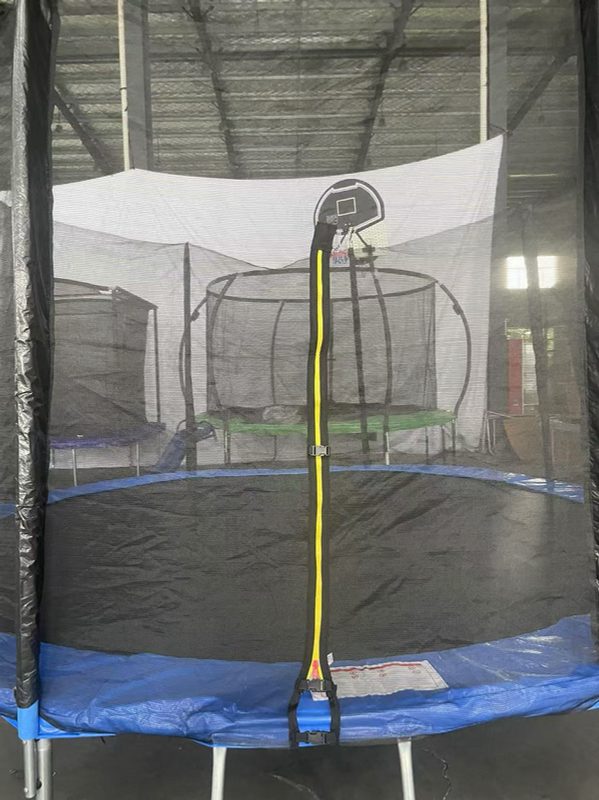
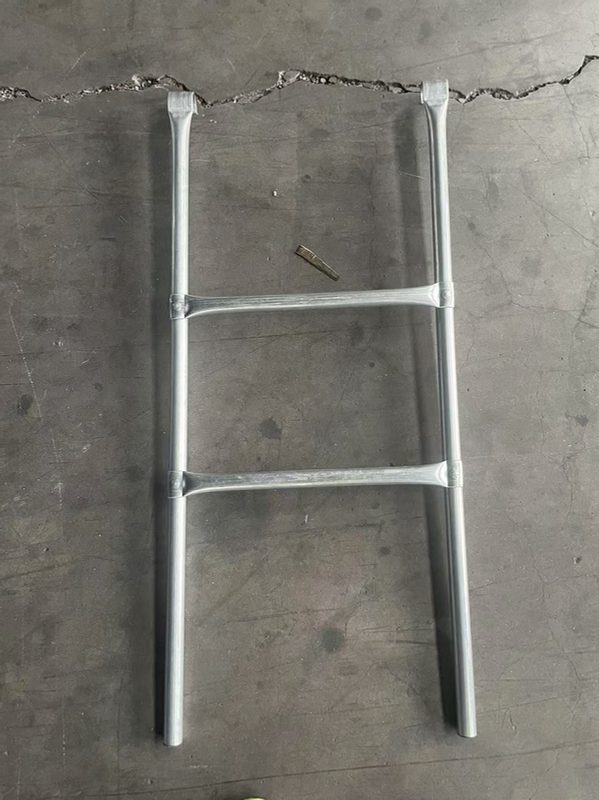
Compliant products carry warning labels at the enclosure entrance and on the ladder. Non-compliant units frequently omit both.
Why do exaggerated weight-capacity claims matter?
Weight-capacity claims are where non-compliant trampolines diverge furthest from reality. In independent ASTM-based testing of a marketplace trampoline advertised with a 1,200 lb capacity:
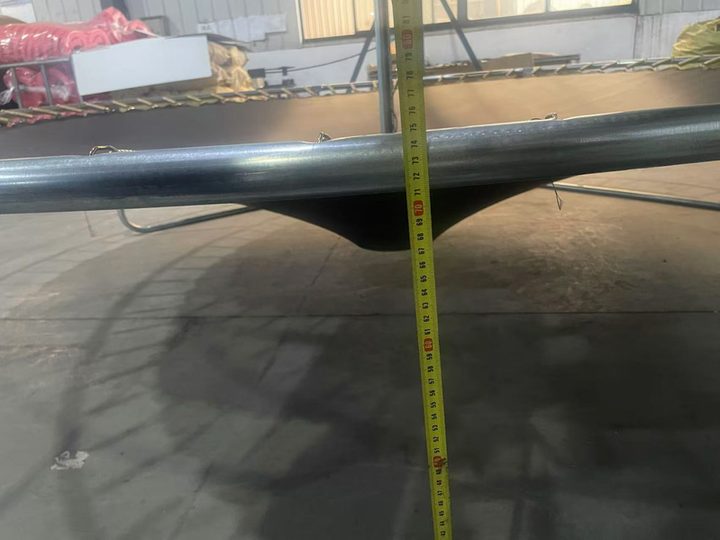
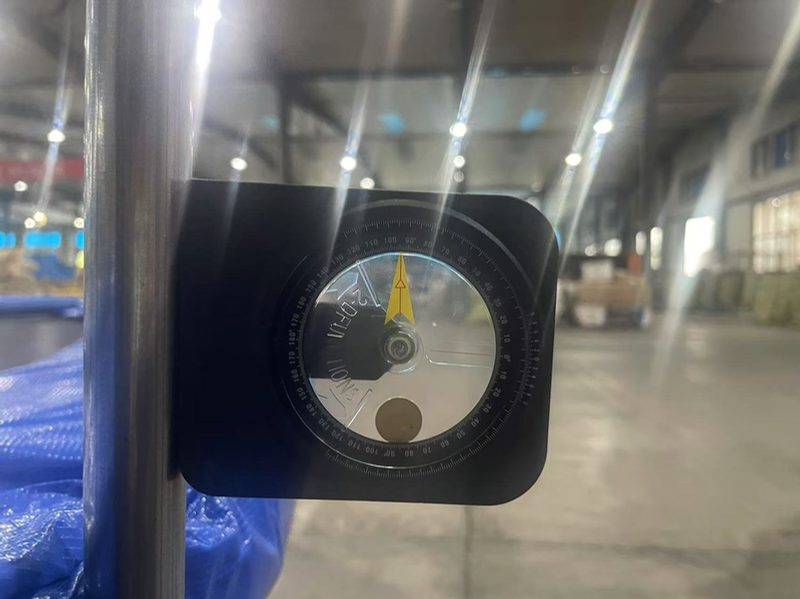
Mat deflection under load, and enclosure pole deformation measured during net impact testing.
A trampoline loaded beyond its true tested capacity can suffer sudden structural failure — bent or collapsed legs, torn mats, and failed springs — while children are on it. Inflated capacity claims also create a false competitive advantage over brands that publish honest, tested ratings.
What safety standards do genuine Sportspower trampolines meet?
Every genuine Sportspower trampoline is designed and tested to meet or exceed the applicable ASTM standards:
- ASTM F381 — the standard consumer safety specification for trampolines, covering frame and mat static load testing, one-jumper labeling, ladder warnings, and a clearly stated maximum user weight.
- ASTM F2225 — the standard for trampoline enclosures, covering net impact performance and warning labeling at the enclosure entrance.
- Honest weight ratings — the capacity printed on a Sportspower product reflects what the product actually passed in testing.
- Complete safety labeling — enclosure, ladder, and frame warnings, plus full safety instructions and a stated maximum user weight in every manual.
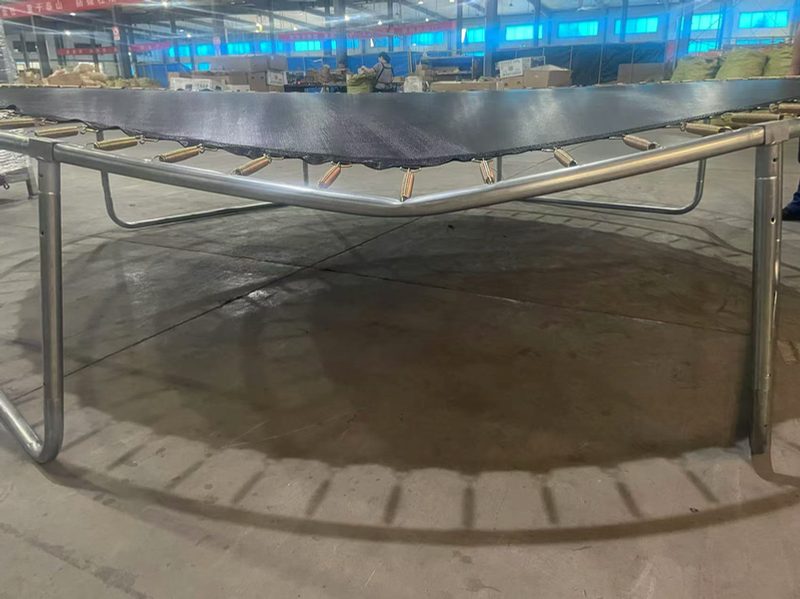
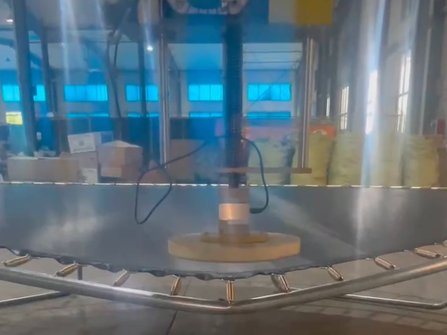
ASTM-based evaluation: the trampoline frame under static load, and the load applicator on the trampoline bed.
Trampoline safety rules every owner should follow
- One jumper at a time. ASTM F381 permits only a single user on the trampoline. Multiple simultaneous jumpers are a leading cause of trampoline injuries, because a smaller jumper can be launched off-balance by a larger one.
- Observe the maximum user weight. Use the weight limit printed on your unit and stated in your manual. Exceeding it risks structural failure of the frame, mat, or springs.
- No somersaults or flips. Landing on the head or neck is the mechanism behind the most severe trampoline injuries.
- Adult supervision at all times. Children should never use a trampoline unsupervised, and trampolines are not recommended for children under six years of age.
- Keep the enclosure zipped and in good repair. The net is a primary safety system, not an accessory. Replace it if it is torn, sun-degraded, or detached.
- Never use water on or around the trampoline. Water on the mat dramatically increases the risk of slips and falls, and no ASTM standard covers this use.
- Anchor the unit and account for wind. Trampolines move in wind and must be properly secured. Because wind conditions vary by location, anchoring is the homeowner's responsibility — see our Manufacturer's Warranty regarding wind damage.
- Remove the ladder when the trampoline is not in use. This prevents unsupervised access by young children.
- Site it properly. Place the trampoline on level ground with generous overhead and side clearance, away from fences, walls, branches, and other play equipment.
- Inspect before each season. Check springs, spring pads, mat stitching, frame welds, and hardware for wear, rust, or damage, and replace worn parts before use.
Swing set and play centre safety
- Anchor every unit. Swing sets must be secured to the ground before use and re-checked each season.
- Maintain a clear use zone. Keep the area in front of and behind swings clear of obstacles, other equipment, and bystanders.
- Use an impact-absorbing surface. Grass alone is not an impact surface. Wood mulch, rubber mulch, or engineered fibre reduces fall injuries.
- One child per swing seat, seated and holding on, never standing or twisting the chains.
- Inspect hardware regularly. Check chains, S-hooks, seats, bolts, and anchors for wear, corrosion, and loosening.
- Remove hood strings, scarves, and helmets before play — they present a strangulation hazard on play equipment.
Why this matters to families and to honest retailers
Counterfeit and salvage listings put children on equipment that has never been verified safe, and they leave the buyer without warranty support when something goes wrong. They also undercut the authorized retailers who stock genuine, tested product and stand behind it. Removing these listings protects both.
Frequently asked questions
How much weight can a trampoline really hold?
Single-user residential trampolines are typically ASTM-tested to a maximum user weight of about 220 lbs. Listings claiming 800–1,200 lbs are describing capacities far beyond what ASTM static load testing supports, and in independent testing such products have failed at a small fraction of the advertised number.
Is it safe for more than one child to jump on a trampoline at the same time?
No. ASTM F381 permits only one jumper at a time. Multiple simultaneous jumpers are a leading cause of trampoline injuries, which is why marketing images showing several children jumping together violate the standard.
What age should a child be to use a trampoline?
Trampolines are not recommended for children under six years of age, and all use should be supervised by an adult.
Can I put water on my trampoline?
No. Water on a trampoline mat dramatically increases the risk of slips and falls, and this use is not covered by any ASTM standard or by the product warranty.
Do I need to anchor my trampoline?
Yes. Trampolines move in wind and must be properly secured. Because wind conditions vary by location, anchoring is the homeowner's responsibility, and Sportspower does not warrant damage caused by wind movement.
What is a salvage sale?
A salvage sale is the resale of product that was never meant to reach a customer as new — customer returns, freight- or water-damaged shipments, insurance write-offs, and liquidation pallets — repackaged and listed as new. With trampolines and swing sets, salvage stock is often missing hardware, warning labels, and manuals, and may contain previously stressed or corroded parts.
Is a salvage or returned trampoline covered by the Sportspower warranty?
No. Sportspower warranty coverage extends only to the original purchaser with a receipt and is nontransferable. Someone who buys salvage or resold stock is not the original purchaser, so warranty coverage does not apply.
How do I know if a Sportspower product is genuine?
Buy only from the retailers on the Sportspower authorized sellers list, verify the model number, and be cautious of prices far below every other seller or listings that mention "open box," "customer return," or "repackaged." If you are unsure, contact Sportspower customer service before purchasing.
Does Sportspower authorize third-party marketplace sellers?
Sportspower products are sold through authorized retailers only. If a marketplace seller does not appear on our authorized sellers list, we cannot vouch for the authenticity, condition, or safety of what they are shipping.
Do genuine Sportspower trampolines meet ASTM standards?
Yes. Genuine Sportspower trampolines are designed and tested to meet or exceed ASTM F381 and ASTM F2225, with honest tested weight ratings and complete safety labeling.
What should I do if I think I bought a counterfeit or salvage Sportspower product?
Contact our customer service team with the product listing, seller name, and photos of the product and its labels. We investigate every report.
Report a counterfeit or salvage listing
If you believe a listing or website selling "Sportspower" products is illegitimate, or you have questions about safe use, assembly, replacement parts, or whether a product is genuine, please contact us. Include the listing link, the seller name, and any photographs you have.
Phone: 1-866-370-2131 (Mon–Fri, 9am–5pm Eastern Time) Email: customerservice@sportspowerltd.net
Thank you for your time, and thank you for choosing Sportspower Ltd!